
- Diagnostic Instruments
- Scalpels & Dissecting Knives
- Scissors & Plaster Instruments
- Dressing & Tissue Forceps
- Hemostatic & Dressing Forceps
- Retractors
- Suction & Access Instruments
- Needle Holders & Suturing Instruments
- Bone Surgery Instruments
- Ophthalmic Instruments
- ENT Instruments
- Urology Instruments
- Intestinal & Rectal Instruments
- Gynecology & Obstetrics Instruments
- Hollow Wares
- Dissecting & Laboratory Instruments








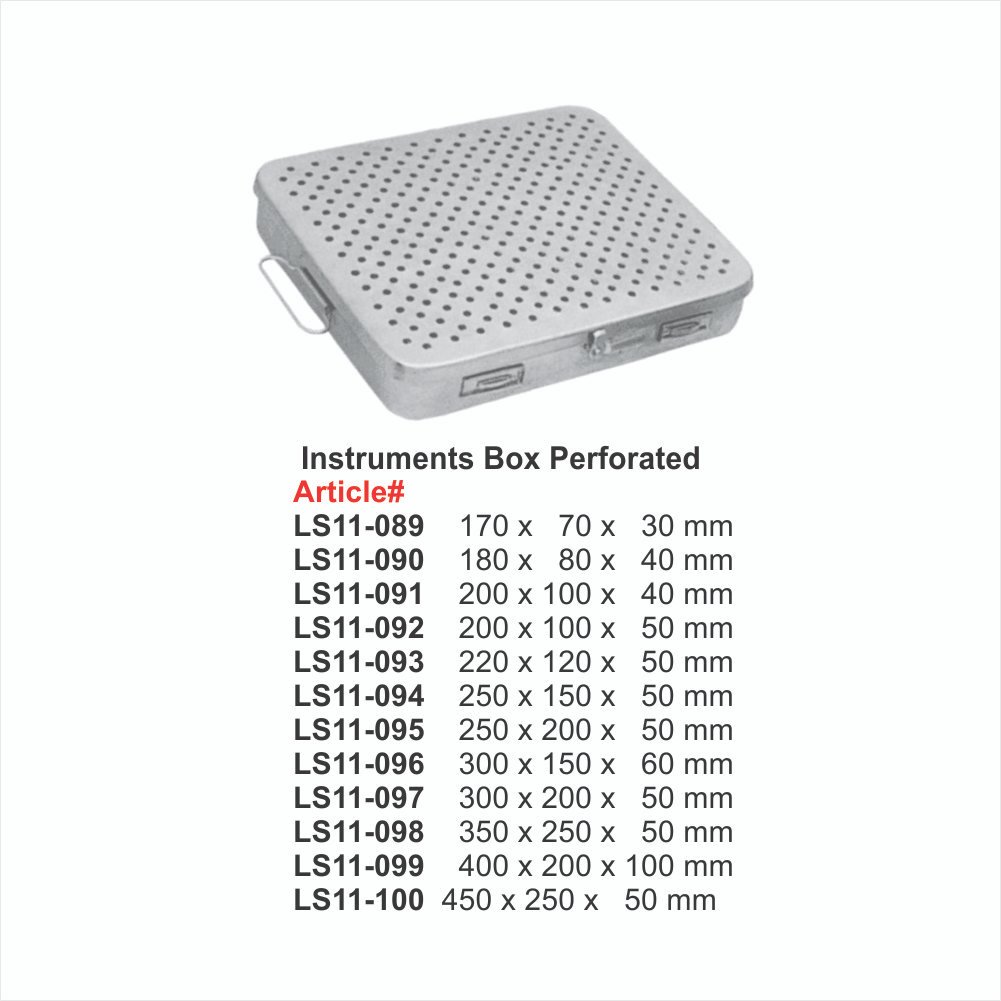
Perforated Sterilization Container
Rectangular stainless-steel container with fully perforated lid for rapid, wrapping-free instrument sterilization.
Key Features:
• Available in 12 size configurations: 170×70×30 mm up to 450×250×50 mm
• Rectangular body with matching perforated lid for full sterilant penetration
• Grid of small circular perforations across lid surface allows steam, EtO, or plasma flow
• Solid body walls contain instruments securely while maintaining sterilant access
• Two wire-formed side handles for safe, ergonomic lifting
• Two front flip-latch closures lock lid firmly during sterilization and transport
• Deep internal clearance in larger variants accommodates bulkier instrument sets
• Smooth stainless-steel finish tolerates repeated autoclaving without perforation deformation
• Compatible with general surgery, orthopedic, neurosurgical, and cardiac instrument sets
• Stackable design maximizes autoclave chamber capacity and operational efficiency
SKU:
LS11-089
Categories: Dental, Hollowware Instruments, Hollowware Instruments
Perforated Sterilization Container
The Perforated Sterilization Container is available in twelve size configurations spanning Article# LS11-089 through LS11-100, with dimensions ranging from 170×70×30 mm up to 450×250×50 mm. The complete range covers 170×70×30, 180×80×40, 200×100×40, 200×100×50, 220×120×50, 250×150×50, 250×200×50, 300×150×60, 300×200×50, 350×250×50, 400×200×100, and 450×250×50 mm. Each container features a rectangular stainless-steel body with a matching perforated lid, both surfaces carrying a uniform grid of small circular perforations across their entire face area. Two wire-formed side handles mount on opposing short walls, and two front-facing flip-latch closures lock the lid firmly against the body during sterilization cycles and transport.
The sterilisation containers perforated lid and body construction allows unrestricted steam, ethylene oxide, or hydrogen peroxide plasma sterilant penetration from all directions simultaneously, reducing sterilization cycle time compared to solid-wall containers. The stainless-steel body walls remain unperforated, containing instruments securely while the lid and base perforations handle sterilant flow. The 400×200×100 mm variant offers the deepest internal clearance for bulkier instrument sets, while the 170×70×30 mm configuration handles compact specialty instrument selections. All twelve variants tolerate repeated autoclave cycles without perforation deformation or latch mechanism degradation.
Central sterile supply technicians, theater nurses, and biomedical teams use the Perforated Sterilization Container for wrapping-free instrument sterilization across general surgery, orthopedic, neurosurgical, and cardiac surgical instrument sets. The sterilisation container rectangle format allows efficient tray stacking inside autoclave chambers, maximizing load density per sterilization cycle. The latch closures maintain lid contact throughout the full sterilization and cooling cycle, preventing recontamination before the tray reaches the sterile field.
Leader Surgical manufactures all twelve variants with consistent perforation density, robust latch mechanisms, and uniform wall thickness — producing containers that meet the repeated sterilization demands of high-volume central sterile services departments without structural compromise.
How long do instruments remain sterile?
Sterility is generally maintained for 30 to 180 days, depending on the manufacturer and the type of filter/barrier system used.
We're here to help!
HAVE QUESTIONS?
Fill out the form, and our team will respond promptly to assist with your product inquiries or order support.