
- Diagnostic Instruments
- Scalpels & Dissecting Knives
- Scissors & Plaster Instruments
- Dressing & Tissue Forceps
- Hemostatic & Dressing Forceps
- Retractors
- Suction & Access Instruments
- Needle Holders & Suturing Instruments
- Bone Surgery Instruments
- Ophthalmic Instruments
- ENT Instruments
- Urology Instruments
- Intestinal & Rectal Instruments
- Gynecology & Obstetrics Instruments
- Hollow Wares
- Dissecting & Laboratory Instruments








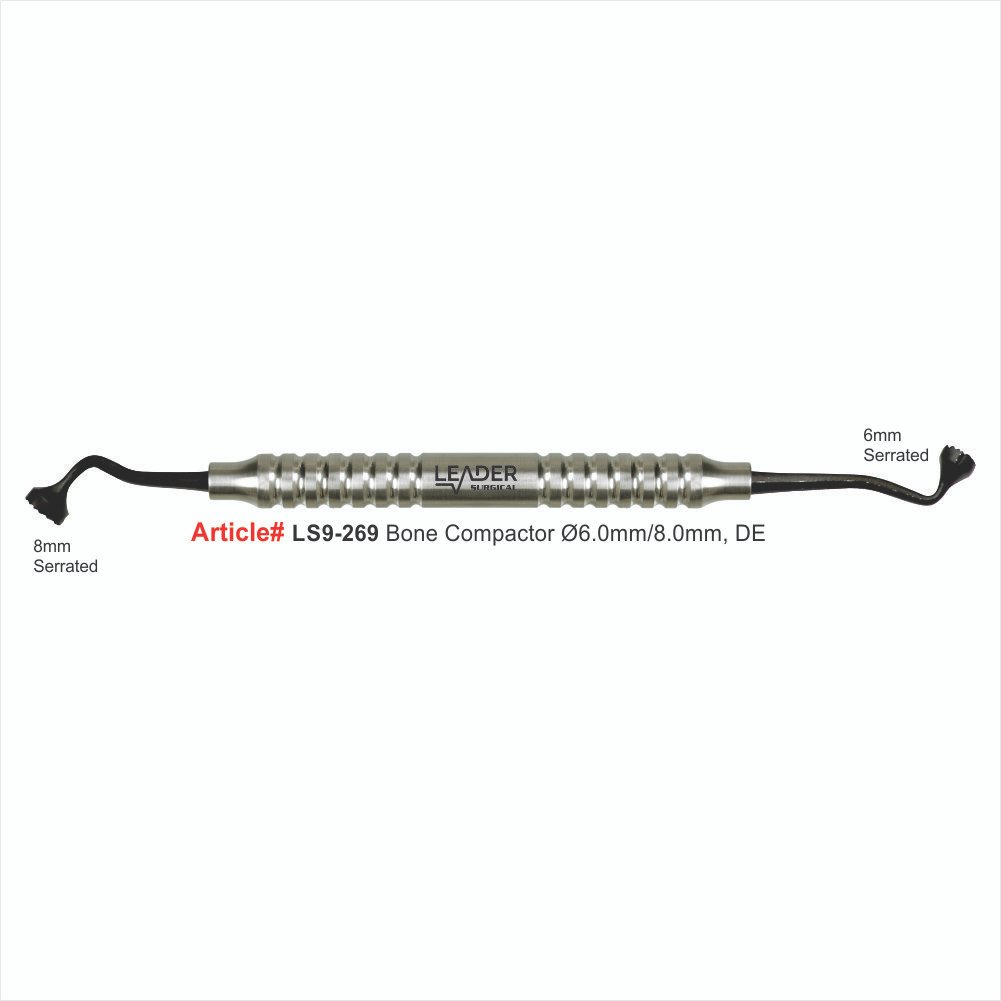
Bone Compactor Ø6.0mm/8.0mm DE
Titanium-coated large-diameter bone compactor with serrated tips for controlled graft condensation in sinus augmentation procedures.
Key Features:
• Double-ended design with Ø6.0mm and Ø8.0mm serrated working tips
• Titanium nitride (TiN) coated tips for enhanced hardness and wear resistance
• Angulated mirror shanks for access in subantral and posterior regions
• Serrated contact surfaces for stable graft engagement and compaction
• Approx. 18.5cm length for balanced intraoral handling
• Knurled cylindrical handle for secure, non-slip grip
• Surgical-grade stainless steel body with corrosion-resistant finish
• Autoclavable at 134°C with durable coating for repeated sterilization cycles
SKU:
LS9-269
Categories: Dental, Implant Instruments, Implantology
Bone Compactor Ø6.0mm/8.0mm DE
The Bone Compactor Ø6.0mm/8.0mm DE is constructed from surgical-grade stainless steel with a knurled cylindrical handle approximately 18.5 cm in overall length. Two opposing sharply angled shanks carry the working ends; one bearing an 8mm serrated tip and the other a 6mm serrated tip in mirrored orientation. Both tips receive a titanium nitride coating applied over the stainless-steel base, producing the visible dark surface finish. This hard ceramic-like layer increases surface hardness, lowers the coefficient of friction at the tip face, and reduces debris adhesion during active graft condensation.
Classified as a large diameter bone compactor, this instrument addresses the widest compaction diameters in the standard bone compactor size range. The 8mm end covers the broadest subantral graft zones following lateral window osteotomy, while the 6mm end handles adjacent narrower segments within the same surgical field. The titanium nitride surface maintains its integrity through repeated autoclave sterilization cycles at 134°C, resisting both corrosive degradation and surface staining that can accumulate on uncoated instruments over time.
Oral and maxillofacial surgeons and implantologists use this instrument during lateral sinus augmentation procedures for subantral graft packing in the posterior maxilla. After elevating the Schneiderian membrane through the lateral window approach and introducing particulate graft material into the subantral space, the surgeon selects the 6mm or 8mm serrated end to condense the graft firmly against the sinus floor and lateral walls, building adequate vertical bone volume for implant fixture placement.
When implant teams want instruments that perform identically from the first sterilization cycle to the hundredth, Leader Surgical delivers, sourcing tools where coating quality, tip geometry, and material longevity are held to the same standard as the surgeries they support.
What is the difference between a “Compactor” and a “Packer”?
While the terms are often used interchangeably, a packer primarily uses manual pressure to push material into a defect, whereas a compactor is specifically designed to densify the material to improve the primary stability of a future implant.
We're here to help!
HAVE QUESTIONS?
Fill out the form, and our team will respond promptly to assist with your product inquiries or order support.