
- Diagnostic Instruments
- Scalpels & Dissecting Knives
- Scissors & Plaster Instruments
- Dressing & Tissue Forceps
- Hemostatic & Dressing Forceps
- Retractors
- Suction & Access Instruments
- Needle Holders & Suturing Instruments
- Bone Surgery Instruments
- Ophthalmic Instruments
- ENT Instruments
- Urology Instruments
- Intestinal & Rectal Instruments
- Gynecology & Obstetrics Instruments
- Hollow Wares
- Dissecting & Laboratory Instruments








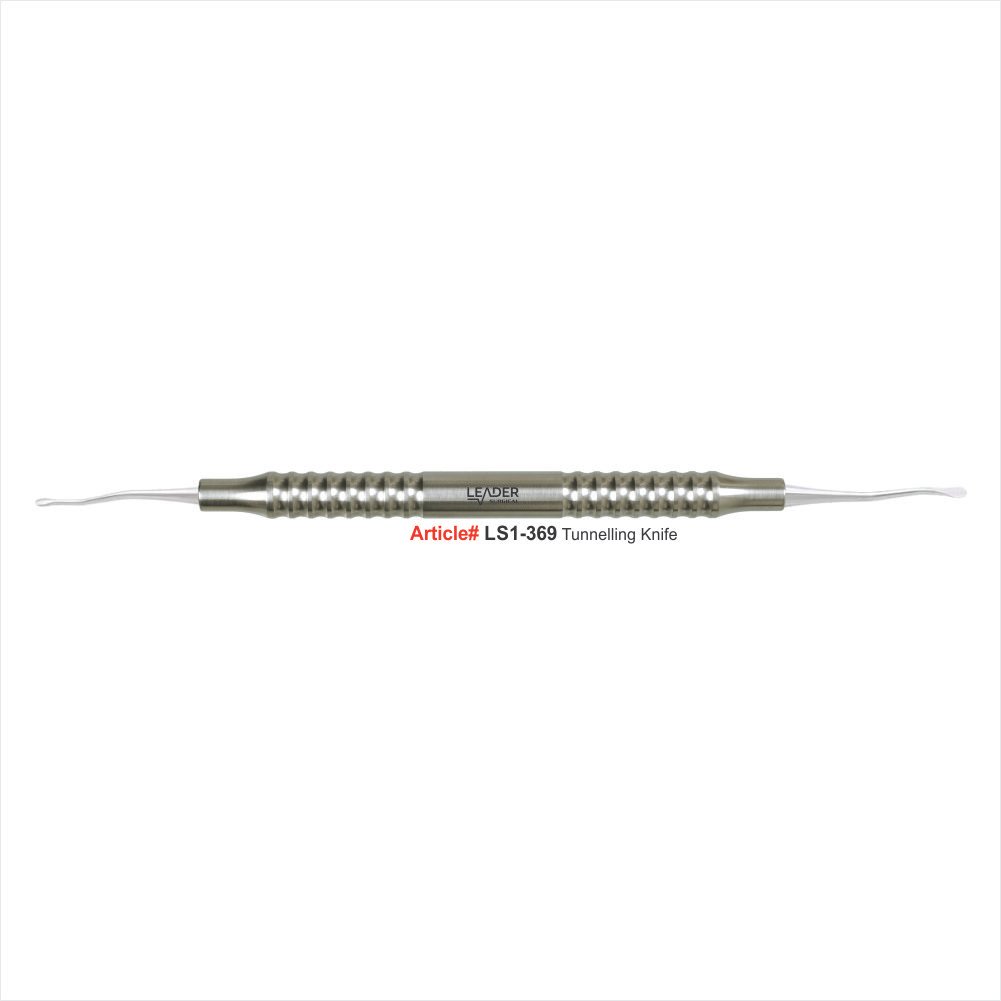
Tunneling Knife fig. 1
Double-ended periodontal tunnelling knife with curved spoon-shaped blades for controlled subperiosteal tissue release in root coverage procedures.
Key Features:
• Double-ended design with matching curved spoon-shaped blade tips
• Thin, flat blades with smooth rounded toe for atraumatic tissue release
• Long tapered shanks with gradual upward blade curvature
• Solid stainless steel construction with matte satin finish
• Knurled cylindrical handle with uniform ribbed grip
• Interchangeable working ends to reduce instrument changes
• Designed for subperiosteal tunnelling and papilla mobilization
• Fully autoclavable with resistance to surface wear and deformation
SKU:
LS1-369
Categories: Dental, Diagnostic and Periodontal Instruments, Periodontal Instruments
The Tunneling Knife Fig. 1 (LS1-369) is a double-ended periodontal microsurgery instrument featuring two curved, spoon-shaped working ends of matching profile on both sides. The central handle carries a knurled cylindrical grip with closely spaced uniform ribbing along the full middle section. Both shanks run in a long, gradual taper before curving upward into shallow curved blade ends. The complete instrument body uses solid stainless steel with a matte satin surface finish from tip to tip.
Each working end presents a thin, flat curved blade face with a smooth rounded toe — distinct from ball-tipped tunnelling instruments. The shallow blade curve allows the tip to slide along subperiosteal tissue planes without snagging connective tissue fibers. As a Periodontal Knife Fig. 1/2 – Double Ended instrument, both ends remain interchangeable during a procedure, reducing the need for instrument handoffs at the surgical tray. The stainless-steel construction holds up through repeated steam autoclave sterilization without blade edge deformation or handle surface degradation.
Periodontists use the Tunneling Knife Fig. 1 during the tunnel technique for root coverage surgery targeting multiple recession defects. After creating a sulcular incision, the surgeon advances this instrument subperiosteally to develop a tissue tunnel across multiple adjacent teeth. The curved blade tip releases connective tissue attachments along the tunnel walls, creating enough pouch space to seat a connective tissue graft without vertical releasing incisions. The Tunneling Knife 1 X blade profile also suits papilla mobilization steps during anterior esthetic graft procedures.
Leader Surgical produces this instrument with uniform blade curvature and shank taper consistency across every unit leaving the production line. Periodontal specialty practices and dental school surgical clinics rely on it as a standard soft tissue tunneling tool. The satin finish and blade geometry remain stable through intensive sterilization schedules and sustained daily clinical use without measurable wear.
What is the primary use of the Fig. 1 Tunneling Knife?
It is designed for minimally invasive periodontal plastic surgery. Its specific shape allows surgeons to undermine and separate the gum tissue from the bone to create a “tunnel” for soft tissue grafts without making large external incisions.
We're here to help!
HAVE QUESTIONS?
Fill out the form, and our team will respond promptly to assist with your product inquiries or order support.