
- Diagnostic Instruments
- Scalpels & Dissecting Knives
- Scissors & Plaster Instruments
- Dressing & Tissue Forceps
- Hemostatic & Dressing Forceps
- Retractors
- Suction & Access Instruments
- Needle Holders & Suturing Instruments
- Bone Surgery Instruments
- Ophthalmic Instruments
- ENT Instruments
- Urology Instruments
- Intestinal & Rectal Instruments
- Gynecology & Obstetrics Instruments
- Hollow Wares
- Dissecting & Laboratory Instruments







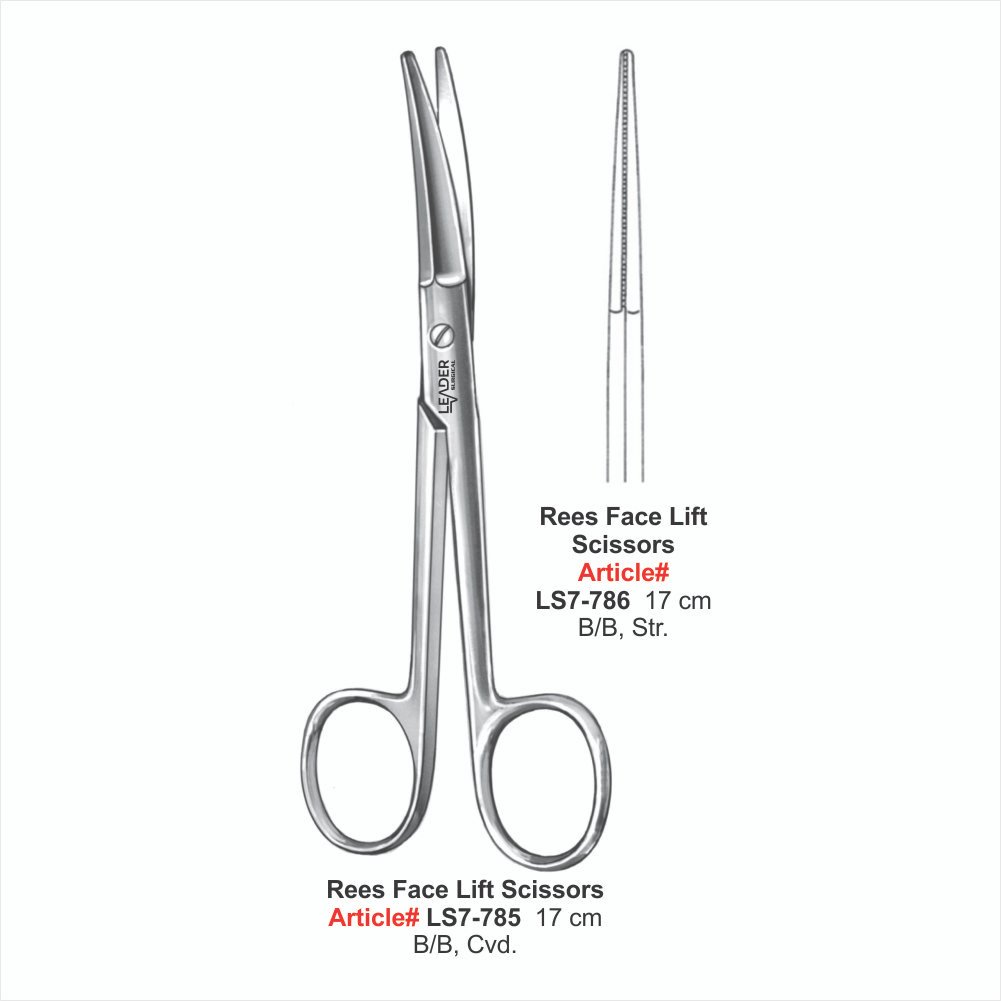
Rees Face Lift Scissors 17 cm B/B (Cvd.)
17 cm curved facelift scissors manufactured from surgical-grade stainless steel, designed for smooth subcutaneous flap elevation and contour-following tissue dissection.
Key Features:
• 17 cm working length reaches extended facial and cervical dissection zones
• Curved blade pattern follows cheek, jawline, and neck contours
• Blunt/blunt (B/B) tips help protect underlying neurovascular structures
• Fine-serrated blade surface improves tissue purchase during undermining
• Smooth opposing blade promotes clean tissue passage
• Curvature supports consistent flap plane development across facial anatomy
• Adjustable screw-joint maintains precise blade tension and tracking
• Satin-finished stainless steel minimizes glare under surgical illumination
Rees Face Lift Scissors 17 cm B/B (Cvd.)
The Rees Face Lift Scissors 17 cm B/B (Cvd.) span 17 centimeters in total length and carry a gentle uniform curvature along both blades from pivot to tip. Both tips are blunt, eliminating any sharp point that could penetrate delicate facial structures during tissue movement. The body is forged from surgical-grade stainless steel with a matte satin finish. Two oval ring handles sit at the base, separated by a screw-joint that controls blade tension and allows smooth, repeatable opening strokes without wobble.
The curved blade geometry follows the natural contour of the face and neck, keeping the cutting plane consistent as the surgeon advances through layered tissue. One blade carries fine inner-edge serrations to grip soft tissue and prevent slippage, while the opposing blade remains smooth for clean passage. The instrument is fully autoclavable and maintains its dimensional geometry through repeated sterilization cycles. At 17 centimeters, the curved facelift scissors reach deeper tissue pockets without hand repositioning mid-dissection.
Facial plastic surgeons use the TC Rees Face Lift Scissors 6 3/4 (17 CM) during rhytidectomy to raise subcutaneous flaps across the preauricular, postauricular, and temporal regions. The curved blade follows the anatomical arc of the cheek and jawline, letting the surgeon dissect toward the nasolabial fold while keeping a uniform fat layer on the skin flap underside. The blunt tips also shield the great auricular nerve during neck dissection.
For surgeons who demand consistent instrument performance across every case, Leader Surgical delivers, their facial surgery instruments reflect a manufacturing philosophy where dimensional accuracy and material integrity are never compromised.
What are the primary uses for these scissors?
These scissors are specifically engineered for delicate and intricate dissection during facelift (rhytidectomy) procedures. They are commonly used to dissect tissue planes such as the platysma and SMAS, but are also versatile enough for ENT, oral & maxillofacial, and general reconstructive surgeries.
We're here to help!
HAVE QUESTIONS?
Fill out the form, and our team will respond promptly to assist with your product inquiries or order support.