- Diagnostic Instruments
- Scalpels & Dissecting Knives
- Scissors & Plaster Instruments
- Dressing & Tissue Forceps
- Hemostatic & Dressing Forceps
- Retractors
- Suction & Access Instruments
- Needle Holders & Suturing Instruments
- Bone Surgery Instruments
- Ophthalmic Instruments
- ENT Instruments
- Urology Instruments
- Intestinal & Rectal Instruments
- Gynecology & Obstetrics Instruments
- Hollow Wares
- Dissecting & Laboratory Instruments







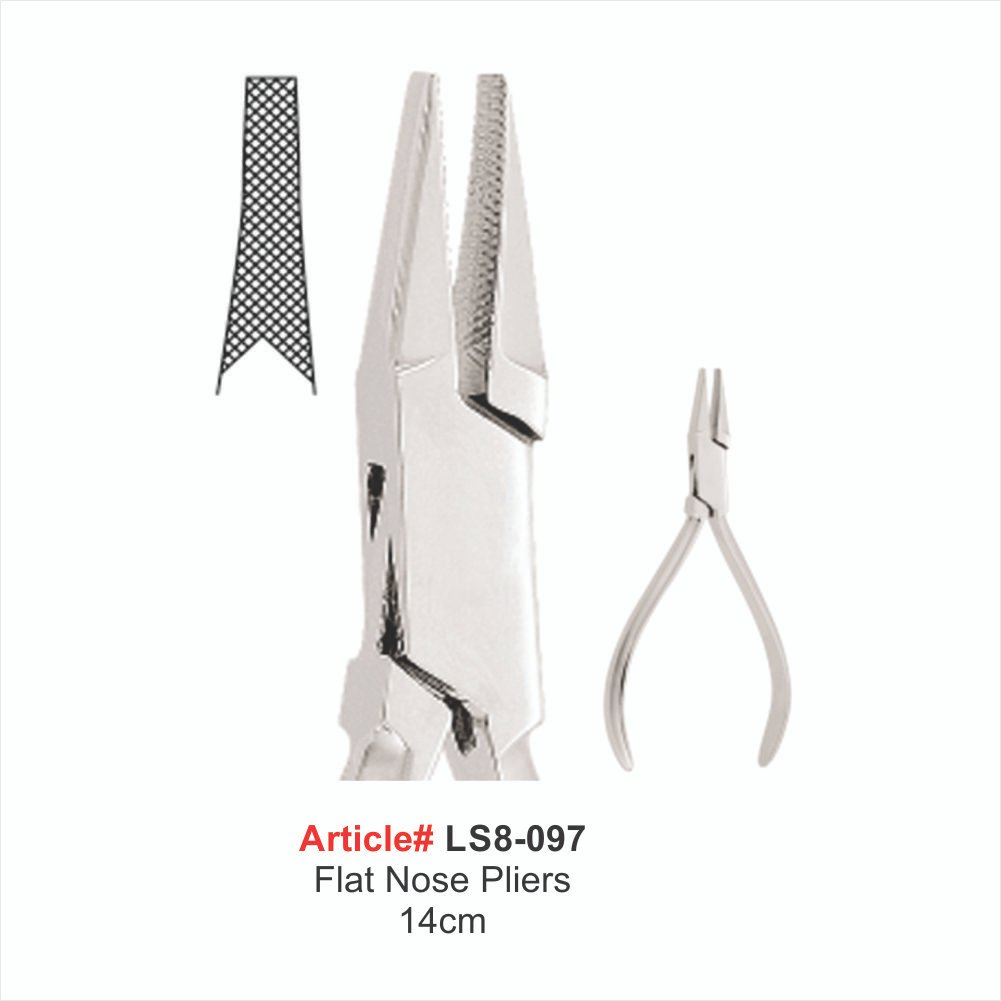
Flat Nose Pliers 14cm
Orthodontic flat nose pliers designed for controlled gripping and accurate bending of archwires during routine clinical and laboratory use.
Key Features:
• German stainless-steel construction for durability and corrosion resistance
• 14cm length with reinforced jaw block for stable handling
• Flat parallel jaws with diamond serrations ensure firm, non-slip grip
• V-notched tip allows precise seating of fine wires
• Suitable for stainless steel and TMA archwires
• Box-joint pivot maintains consistent jaw alignment
• Satin finish reduces glare during chairside work
• Autoclavable at 134°C for standard sterilization cycles
SKU:
LS8-097
Categories: Dental, Ortho and Prosthetic Pliers, Orthodontic Instruments
Flat Nose Pliers 14cm
At 14 cm long, the Flat Nose Pliers 14cm carries a heavier jaw block than slimline counterparts. Forged German stainless-steel forms the body. Two parallel beaks present wide, flat gripping faces with diamond cross-cut serrations on the inner surface. A v-notched tip profile sits at the jaw edge for thin-wire seating. The box-joint pivot sits flush within the jaw shoulder, while looped handle shanks return through spring tension.
The instrument tolerates steam autoclaving at 134°C, ultrasonic cleaning baths, and chemical cold-soak immersion without surface compromise. Closure parallelism stays intact after years of forming work. The riveted box-joint resists splay even under the load of square stainless archwires. A reasonable nose plier price for full surgical-grade construction keeps procurement officers content with repeat orders. Handle ridges supply non-slip purchase during high-torque bending tasks, and the satin finish dulls operatory light reflections.
Across orthodontic wire-bending tasks, the Flat Nose Pliers 14cm functions as a workhorse. It forms stops, bayonet bends, and U-loops in stainless steel and TMA archwires. The orthodontist clamps the wire flat between the broad serrated faces. A roll or rotation of the handle then sets the desired angle. The notched tip seats small-diameter wires for tight folds. A Flat Nose Pliers & Cutter kit covers the full cut-and-bend workflow.
Steel hardness verification anchors the quality pipeline at Leader Surgical. Every incoming batch faces Rockwell testing before it ever reaches the forging hammer. The bench targets 52 to 56 HRC for plier jaws, the range where edge memory holds without becoming brittle. Test coupons travel alongside production lots, allowing cross-checks at any stage. Rejected steel returns to the supplier, stopping soft jaws and warped tips from reaching dental offices.
How do they differ from needle-nose pliers?
Needle-nose (or chain-nose) pliers have long, tapered tips for reaching into tight spaces. Flat nose pliers have wider, stubby jaws that provide more surface area and stability for bending larger or flatter components.
We're here to help!
HAVE QUESTIONS?
Fill out the form, and our team will respond promptly to assist with your product inquiries or order support.