
- Diagnostic Instruments
- Scalpels & Dissecting Knives
- Scissors & Plaster Instruments
- Dressing & Tissue Forceps
- Hemostatic & Dressing Forceps
- Retractors
- Suction & Access Instruments
- Needle Holders & Suturing Instruments
- Bone Surgery Instruments
- Ophthalmic Instruments
- ENT Instruments
- Urology Instruments
- Intestinal & Rectal Instruments
- Gynecology & Obstetrics Instruments
- Hollow Wares
- Dissecting & Laboratory Instruments








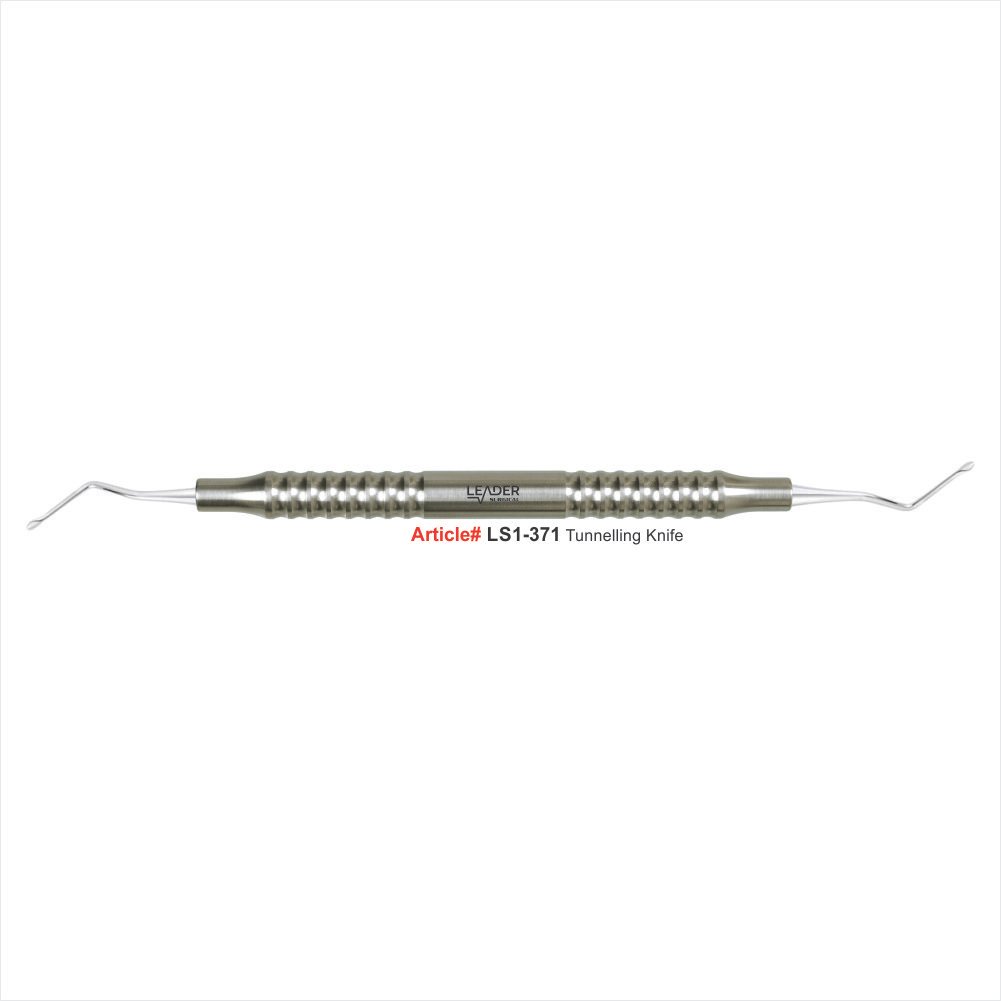
Periodontal Knife Fig. 3/4
Double-ended periodontal tunnelling knife with oppositely curved blades for controlled subperiosteal tissue release in multi-tooth root coverage procedures.
Key Features:
• Double-ended design with Fig. 3 (shallow) and Fig. 4 (steep) curved blades
• Thin, flat blade faces with smooth rounded toe for atraumatic separation
• Opposing blade angulation for lateral and papillary tunnel access
• Long tapered shanks for controlled subperiosteal navigation
• Solid stainless steel construction with matte satin finish
• Knurled cylindrical handle with uniform ribbed grip
• Crane-Kaplan blade geometry for periodontal tunnelling procedures
• Fully autoclavable with resistance to deformation and surface wear
SKU:
LS1-371
Categories: Dental, Diagnostic and Periodontal Instruments, Periodontal Instruments
Periodontal Knife Fig. 3/4
The Periodontal Knife Fig. 3/4 (LS1-371) is a double-ended periodontal microsurgery instrument with two oppositely curved blade ends — the left end angles upward with a shallow lateral sweep while the right end curves more steeply with a tighter blade arc. The central handle carries a knurled cylindrical grip with closely spaced uniform ribbing across the full middle section, transitioning into long smooth tapered shanks at both ends. Both working blades sit offset from the instrument’s long axis in opposing directions. The entire body uses solid stainless-steel construction with a matte satin finish throughout.
Each blade end presents a thin, flat curved face with a smooth rounded toe for clean tissue separation along subperiosteal planes. The left Fig. 3 blade addresses wider lateral tunnel corridors, while the right Fig. 4 end reaches tighter papillary and interdental zones requiring a steeper approach angle. As a Periodontal Knife Fig. CK-3 design, this instrument follows the Crane-Kaplan blade geometry standard established for periodontal soft tissue tunneling work. Stainless steel construction tolerates repeated steam autoclave sterilization without blade curvature shift or shank surface wear.
Periodontists use the Periodontal Knife Fig. 3/4 during advanced tunnel technique procedures for root coverage surgery targeting Class I and Class II Miller recession defects. The Fig. 3 blade develops the lateral pouch extent along the mid-facial ridge, while the Fig. 4 end releases papillary attachments to achieve complete tunnel mobility before connective tissue graft insertion. Clinicians searching to Buy Tunnel Knife 3 Online use this instrument as a direct companion to the Fig. 1/2 set during multi-tooth anterior recession correction.
Leader Surgical produces this knife with blade offset angles and shank taper dimensions held to uniform tolerances across every production unit. Periodontal specialty practices and university dental surgery departments stock it as a core tunneling instrument completing the full Fig. 1 through Fig. 4 soft tissue surgery setup.
What does the “Fig. 3” designation indicate?
Figure 3 typically refers to a specific angulation or blade shape within a tunneling set. It is often a double-ended or uniquely angled instrument designed to reach difficult lateral and posterior areas of the mouth that straight knives cannot access.
We're here to help!
HAVE QUESTIONS?
Fill out the form, and our team will respond promptly to assist with your product inquiries or order support.