
- Diagnostic Instruments
- Scalpels & Dissecting Knives
- Scissors & Plaster Instruments
- Dressing & Tissue Forceps
- Hemostatic & Dressing Forceps
- Retractors
- Suction & Access Instruments
- Needle Holders & Suturing Instruments
- Bone Surgery Instruments
- Ophthalmic Instruments
- ENT Instruments
- Urology Instruments
- Intestinal & Rectal Instruments
- Gynecology & Obstetrics Instruments
- Hollow Wares
- Dissecting & Laboratory Instruments








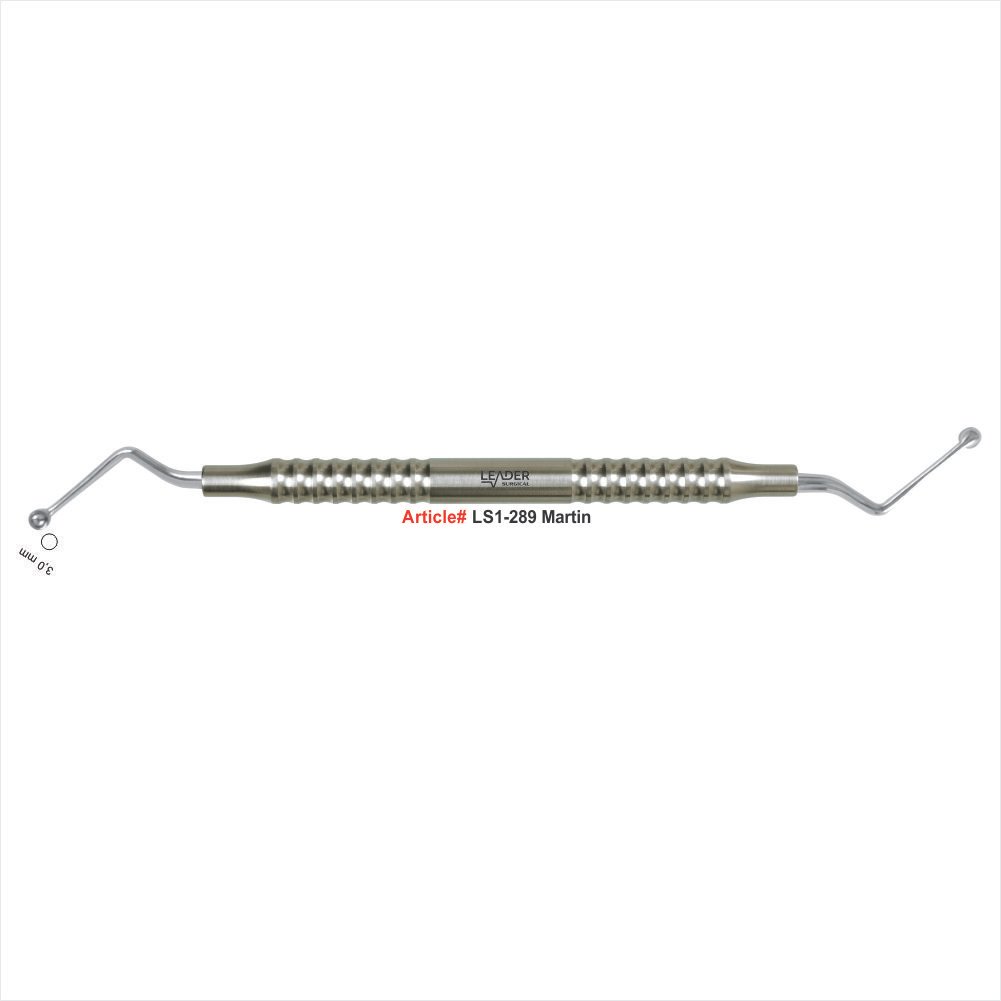
Martin Curettes Fig.2
Double-ended 3.0 mm sinus curette designed for controlled elevation of the Schneiderian membrane during lateral window sinus lift procedures.
Key Features:
• Double-ended curette with mirror-image spoon blades
• 3.0 mm concave cup-shaped working ends
• Semi-sharp rim edges for controlled scraping along sinus floor
• Opposing terminal shank angulation for dual approach access
• Overall length 165 mm (6.5 in) with balanced mid-handle control
• Round ringed knurled handle for secure rotational grip
• Manufactured from surgical-grade stainless-steel
• Fully autoclavable at 134°C for repeated surgical sterilization
SKU:
LS1-289
Categories: Curettes, Dental, Diagnostic and Periodontal Instruments
Martin Curettes Fig.2
The Martin Curettes Fig.2 is a double-ended sinus curette with mirror-image working ends, each measuring 3.0 mm in width as confirmed by the LS1-289 article reference and product image dimensions. Both blades carry a concave, spoon-shaped cup with semi-sharp rim edges angled to slide against the maxillary sinus floor while maintaining controlled membrane contact. The terminal shank bends toward opposite directions on each end, providing two distinct approach angles from a single instrument during subantral membrane elevation. The round ringed knurled handle is machined from surgical-grade stainless-steel, allowing free axial rotation between two fingers throughout the elevation sequence. Overall instrument length measures 165 mm (6.5 inches), balancing consistently at mid-handle.
The 3.0 mm blade width on the Sinus Lift Instrument Fig.2 covers standard subantral space dimensions at the initial membrane release stage, after the narrower Fig.1 variant has established the entry plane. The semi-sharp rim edges allow the blade to scrape along the cortical sinus floor while the concave face cups the membrane upward without generating point-contact perforation risk. The stainless-steel body withstands autoclave sterilization at 134°C across repeated cycles without shank distortion or surface oxidation.
Oral surgeons and implantologists use Martin Curettes Fig.2 during lateral window sinus floor augmentation when posterior maxillary bone height falls below 5 mm. The clinician inserts the blade through the lateral osteotomy window and works it along the sinus floor, releasing the Schneiderian membrane from the mesial wall, distal wall, and medial sinus wall progressively before graft material placement. Short sweeping strokes with consistent blade-to-bone contact prevent membrane tears during the elevation sequence.
Leader Surgical brings the same no-compromise approach to every instrument it produces — because in a surgical setting, the tool either performs exactly as needed or it doesn’t belong in the tray.
Are there different handle designs available?
Yes, you can find them with octagonal handles for better grip, or hollow/ergonomic handles designed to reduce hand fatigue during long surgeries.
We're here to help!
HAVE QUESTIONS?
Fill out the form, and our team will respond promptly to assist with your product inquiries or order support.