
- Diagnostic Instruments
- Scalpels & Dissecting Knives
- Scissors & Plaster Instruments
- Dressing & Tissue Forceps
- Hemostatic & Dressing Forceps
- Retractors
- Suction & Access Instruments
- Needle Holders & Suturing Instruments
- Bone Surgery Instruments
- Ophthalmic Instruments
- ENT Instruments
- Urology Instruments
- Intestinal & Rectal Instruments
- Gynecology & Obstetrics Instruments
- Hollow Wares
- Dissecting & Laboratory Instruments








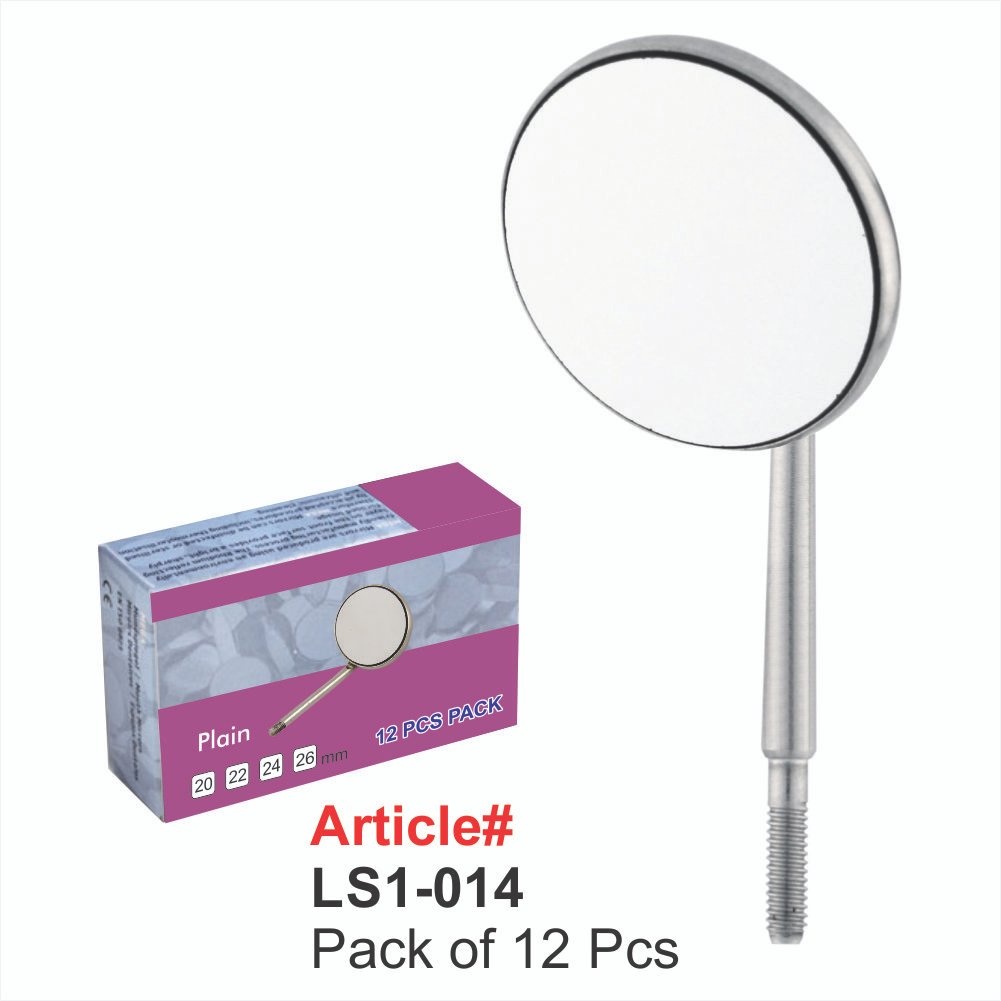
Dental Mouth Mirrors
Diagnostic mouth mirrors with front-surface reflective coatings for distortion-free intraoral visualization.
Key Features:
• Front-surface rhodium or chromium coating eliminates ghost imaging
• Reflective layer thickness: 50–100 nanometers for optical clarity
• Available in #3 (18mm), #4 (20mm), and #5 (24mm) diameters
• Silk-matted stems to minimize light reflection during procedures
• Cone socket threading compatible with American and European handles
• Optional magnifying mirrors with 150–200mm focal length (1.5×–2.5×)
• Anti-fog hydrophilic coating to reduce condensation
• Autoclavable construction for repeated clinical sterilization
SKU:
LS1-014
Categories: Dental, Diagnostic and Periodontal Instruments, Handles & Mirrors
Dental Mouth Mirrors
Dental Mouth Mirrors incorporate front surface rhodium or chromium reflective coatings applied directly to the glass face, eliminating the air-glass interface that causes ghost images in plane mirrors. Available in #3, #4, and #5 sizes measuring 18mm, 20mm, and 24mm respectively, these diagnostic tools feature silk-matted stems that reduce light reflection during procedures. The reflective coating thickness ranges from 50-100 nanometers, providing optical clarity while maintaining durability through repeated chemical exposure and mechanical handling.
Plane mirrors position the reflective layer behind the glass substrate, creating a more economical option that withstands impact better than front surface variants. Cone socket mirror heads attach via tapered threading compatible with standard American or European handle systems. Magnifying mouth mirror designs utilize concave curvature with focal lengths between 150-200mm, producing 1.5x to 2.5x magnification ideal for detecting incipient caries and hairline fractures. Modern variants include anti-fog coatings utilizing hydrophilic compounds that prevent moisture condensation during temperature fluctuations between intraoral and extraoral environments.
Restorative dentists and oral surgeons use Dental Mouth Mirrors to achieve indirect visualization of mandibular lingual surfaces, maxillary palatal regions, and distal molar aspects during cavity preparation and crown seating. The mirror reflects ambient or operatory light onto shadowed areas while simultaneously retracting the cheek, tongue, or lip tissue. Orthodontists employ mirrors during bracket placement to verify adhesive coverage on posterior teeth where direct vision is obstructed by patient anatomy. Endodontists use magnifying variants during access cavity preparation to locate calcified canals and identify additional orifices in complex root systems.
Leader Surgical implements quality verification protocols that test coating adhesion, optical distortion levels, and thread tolerance specifications before releasing mirror heads to distribution channels. Their manufacturing standards ensure reliable performance across diverse clinical applications in general dentistry, specialty practices, and academic training institutions where thousands of examinations depend on accurate visual information.
What is a cone-socket magnifying mouth mirror used for?
It is a standard dental instrument used for various purposes in the oral cavity: indirect vision of hard-to-reach areas, reflecting light to illuminate dark spots, and gentle retraction of soft tissues like the tongue, cheeks, and lips.
We're here to help!
HAVE QUESTIONS?
Fill out the form, and our team will respond promptly to assist with your product inquiries or order support.