- Diagnostic Instruments
- Scalpels & Dissecting Knives
- Scissors & Plaster Instruments
- Dressing & Tissue Forceps
- Hemostatic & Dressing Forceps
- Retractors
- Suction & Access Instruments
- Needle Holders & Suturing Instruments
- Bone Surgery Instruments
- Ophthalmic Instruments
- ENT Instruments
- Urology Instruments
- Intestinal & Rectal Instruments
- Gynecology & Obstetrics Instruments
- Hollow Wares
- Dissecting & Laboratory Instruments








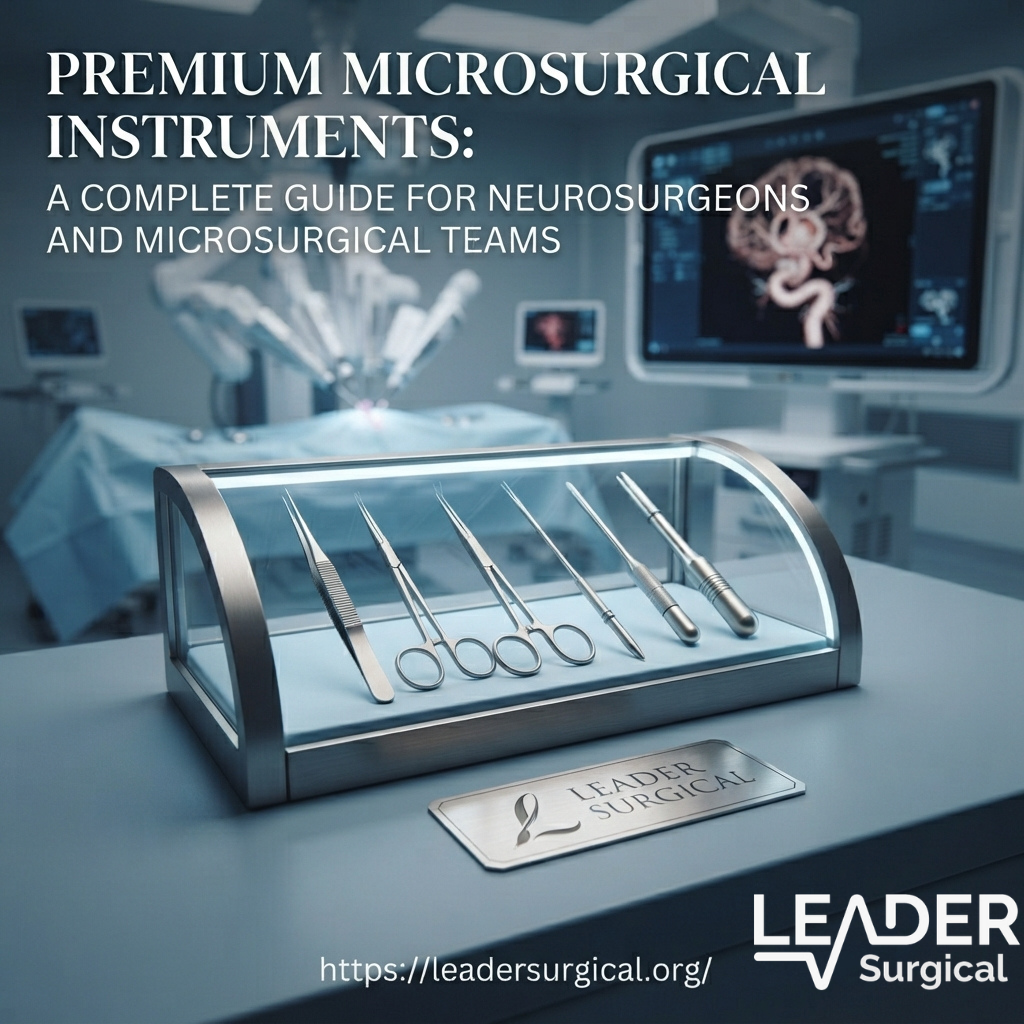
Premium Microsurgical Instruments: A Complete Guide for Neurosurgeons and Microsurgical Teams

What Are Microsurgical Instruments?
Some surgeries leave no room for a shaky hand or a dull blade. When a surgeon is repairing a blood vessel thinner than a strand of spaghetti, the instrument in their hand must be right not just sharp, but precise down to a fraction of a millimetre. That’s the world of microsurgical instruments: scissors, forceps, needle holders, dissectors, and dilators built to work on structures often smaller than 2–3 millimetres, such as fine vessels, nerves, and delicate tissue planes. These aren’t just smaller versions of regular surgical tools they’re built from the ground up for use under a microscope, where every gram of weight, every micron of tip alignment, and every degree of blade curve can change how well a surgeon performs.
In microsurgery, the instrument isn’t a passive tool it’s an extension of the surgeon’s hand. Its design directly shapes precision, control, and fatigue over long procedures. That principle is the foundation of everything Leader Surgical builds.
Why Instrument Precision Directly Affects Surgical Outcomes
Microsurgical procedures — aneurysm clipping, free flap reconstruction, peripheral nerve repair, cerebral bypass, are performed on tissue that leaves almost no room for error. Several bodies of clinical literature support why instrument design matters at this scale:
- Suture-scale precision: Microsurgical suturing often uses threads as fine as 8-0 to 11-0 — thinner than a human hair. Fine-tipped, atraumatic instruments are essential to handle tissue and suture at this scale without causing trauma.
- Non-magnetic construction: Even trace magnetism can cause fine suture needles to stick or deflect unpredictably. Fully non-magnetic instruments keep needle handling consistent.
- Zero Consistency over long procedures: Many microsurgical cases run for hours. Instrument weight, balance, and grip design directly affect a surgeon’s control and hand fatigue late into a case.
Instrument quality isn’t a cosmetic upgrade; it’s directly tied to the control and consistency a surgical team can rely on in procedures with an extremely narrow margin for error.
Types of Premium Microsurgery Instruments
Leader Surgical instrument portfolio is organized around the core toolkit every microsurgical team relies on. Here’s what each category is designed to do.
Micro scissors
Ultra-thin, curved blades for delicate incisions and vessel dissection. Available in standard, serrated (for tougher or re-operative tissue), and mini configurations.
Micro forceps
For grasping and stabilizing tissue without crushing it. Straight and angled tips let surgeons’ approach from different trajectories without repositioning their hand.
Needle Holders
Hold extremely fine needles (down to 10-0) securely without slippage, while staying light enough for hours of continuous use. Straight, curved, and angled variants suit different suturing angles.
Micro Rongeurs & Dilators
Rongeurs remove bone and soft tissue in tight corridors; dilators gently open or size vessels before anastomosis. Both demand fine tip control to avoid trauma to nearby structures.
Micro dissectors
Fine probes that separate tissue planes with minimal disruption, critical for preserving structures during nerve or tumour-margin work.
What Makes a Microsurgical Instrument “Premium”?
Not all instruments in each category perform the same way. The difference between a standard-tier and premium-tier instrument usually comes down to a handful of engineering details:
- Self-sharpening or long-retention cutting edges: Reduces how often an instrument needs replacement or resharpening, preserving cutting performance over more procedures.
- Advanced surface coatings: Such as diamond-like carbon, or DLC — increase surface hardness and durability while reducing glare under microscope lighting.
- Anti-scissoring tip alignment systems: Precisely positioned pivot points that prevent forceps tips from crossing or misaligning, which preserves visibility and grip consistency at the tip.
- Fully non-magnetic construction: As noted above, this is essential for predictable handling of fine suture needles.
- Ergonomic, textured finger grips: Reduce hand fatigue during long procedures, particularly important in bypass or free-flap cases that can run for several hours.
These aren’t arbitrary features they map directly onto the demands described earlier: fine suture handling, long procedure times, and zero tolerance for tip drift under magnification.
Clinical Applications
Microsurgical instruments are specialty tools, and the “who and when” depends heavily on subspecialty:
| Specialist | Typical Procedures | Why Precision Instruments Matter |
| Cerebrovascular / Vascular Neurosurgeons | Aneurysm clipping, cerebral bypass, AVM resection | Operating on vessels often under 2mm; a single slip can compromise blood flow to brain tissue |
| Skull Base / Tumor Neurosurgeons | Meningioma, schwannoma, and skull base tumor resection | Working in confined corridors near cranial nerves and major vessels |
| Plastic & Reconstructive Microsurgeons | Free flap transfer, replantation, lymphatic surgery | Reconnecting vessels and nerves as small as 0.3–2mm to restore blood supply and function |
| Peripheral Nerve Surgeons | Nerve grafting, nerve transfers, nerve repair | Precise fascicle-level dissection to maximize functional recovery |
| Ophthalmic Microsurgeons | Anterior segment and retinal procedures | Sub-millimetres tissue handling inside the eye |
Training institutions build this into formal education for exactly this reason. Mayo Clinic’s neurosurgery residency program, for example, requires residents to complete dedicated microvascular anastomosis training, noting that residents have access to a rat-based microvascular anastomosis lab and formal courses on open skull base techniques, endoscopic skull base techniques, microvascular anastomoses, and peripheral nerve surgery prior to graduation. Instrument familiarity not just technique, is treated as a core competency.
Sterilization Best Practices
Even the best-engineered instrument depends on correct reprocessing to stay safe and effective. General best practice for microsurgical sets:
- Follow the instrument’s care instructions exactly: For cleaning, tray setup, and sterilization parameters.
- Open hinged instruments fully: During sterilization; disassemble removable parts where applicable.
- Clean before every sterilization cycle: Residual bioburden can shield microorganisms during processing.
- Use dedicated, purpose-built trays: To prevent tip-to-tip contact damage, a common cause of premature dulling or misalignment.
This is why Leader Surgical designs matched sterilization trays for each instrument family, reducing handling damage and supporting safe, compliant reprocessing.
FAQs
How are microsurgical instruments different from standard surgical tools?
Finer tips, lighter weight, and non-magnetic construction built for microscope-level precision.
Why must Microsurgery Instruments be non-magnetic?
So fine suture needles don’t stick, jump, or misalign during suturing.
Are self-sharpening scissors maintenance-free?
No, they retain an edge longer but still need regular inspection and proper sterilization.
Do left-handed surgeons need different instruments?
Yes, left-handed versions preserve the same visibility and control as right-handed models.
How often should these instruments be replaced?
Depends on case volume and wear, inspect regularly under magnification and follow care guidance.
Is this article medical advice?
No, it’s educational content for medical professionals and doesn’t replace clinical judgment or official instrument instructions.